silver
the jewelry metal, explained, and the best conductor of electricity known
Silver is widely regarded as the best jewelry metal for its look, not because it is the most expensive, but because its optical and material properties work well with how things actually look, how they are made, and how they hold up over time. It also happens to be the most electrically conductive metal known: a rare intersection of beauty and utility.
Highest reflectivity of any metal
Polished silver reflects more visible light than any other metal, with reflectance exceeding 95% across much of the visible spectrum. Unlike gold, which selectively absorbs blue light, or platinum-group metals, which reflect less intensely, silver produces a neutral, white brilliance. The result: form, surface finish, and gemstone color read accurately, without a color cast. As a result, silver jewelry appears brighter at equal polish and lighting, even when thinner or lighter than comparable pieces made from denser metals.
This high reflectivity also rewards craftsmanship: subtle curves, fine engraving, and tool marks remain visually legible rather than flattened by glare or color bias. In silver, surface quality is not hidden; it is revealed.
Visible-light reflectivity of common metals (polished)
| Metal | Approx. reflectivity | Visual character |
|---|---|---|
| Silver | 95–99% | Bright, neutral white |
| Aluminum | 88–92% | Slightly bluish, diffuse |
| Gold | 70–85% | Warm, yellow-biased |
| Copper | 65–75% | Reddish, absorbs blue |
| Platinum | 60–70% | Soft gray |
| Palladium | 65–75% | Matte gray |
| Nickel | 60–65% | Hard gray |
| Steel | 55–65% | Dull gray |
Ductility, malleability, and expressive range
Silver's extreme ductility allows it to be drawn, hammered, engraved, and formed into complex geometries without cracking. It work-hardens predictably, meaning strength can be introduced locally through forming rather than bulk. This allows silver jewelry to be both visually light and mechanically sound, supporting designs that would be impractical in stiffer or more brittle precious metals.
Pure silver is very soft, highly ductile, and easily scratched or deformed, which is why jewelry uses sterling silver (92.5%) for strength, and why engineering applications balance hardness against conductivity.
Patina as accumulated character
Silver's tendency to tarnish (the slow formation of silver sulfide at the surface) is often treated as a flaw, but in jewelry it functions more like a record of contact. Unlike corrosion that destroys material, silver patina is superficial and stable. It darkens recesses, softens highlights, and increases contrast, emphasizing relief and texture over time.
For many wearers and makers, this patina is not damage but character: a visible history of handling, environment, and use. Polishing can always return silver to full brightness, but the option to let it age gives silver jewelry a temporal dimension that plated or chemically inert metals lack.
Electrically, tarnish behaves differently: silver sulfide increases surface contact resistance, not bulk conductivity. Under pressure or wiping contact, resistance drops again, which is why silver is often plated, burnished, or self-cleaning in switches and relays. The same surface chemistry that ages a ring beautifully also has to be engineered around in a contact.
A short history
Silver was one of the first five metals known to humankind, alongside gold, copper, lead, and iron; objects date back to roughly 4000 BC, with separation from lead mastered by 3000 BC. For much of antiquity it was valued more highly than gold, and it became one of the first metals ever used as currency. The English word traces to the Anglo-Saxon seolfor; notably, it has no true rhyme in the language.
Long before anyone understood why, people trusted silver near food and wounds: coins dropped into water casks on long voyages, foil pressed into battlefield injuries. The folk wisdom about a silver spoon had a real, measurable payoff: infants whose families used silver got sick less. The same property that keeps a wound clean is the property that keeps a mirror bright, and silver has never really had to choose between being useful and being beautiful.
Why silver conducts so well
Electrical conductivity depends on how easily electrons move through a material. Silver's atomic structure is nearly ideal for this: one loosely bound valence electron per atom, a face-centered cubic (FCC) crystal structure, and minimal electron scattering within the lattice. At room temperature, silver has the lowest electrical resistivity of any metal.
Ag, atomic number 47, atomic weight 107.8682. Melting point 961.78°C, boiling point 2162°C, density 10.5 g/cm³.
| Metal | Resistivity (Ω·m ×10⁻⁸) |
|---|---|
| Silver | 1.59 |
| Copper | 1.68 |
| Gold | 2.44 |
| Aluminum | 2.82 |
| Iron | 9.71 |
Lower resistivity means higher conductivity.
Electrical vs. thermal conductivity
Silver also dominates thermal conductivity: it is the best heat conductor among metals, rapidly transferring thermal energy, and is used in high-performance heat spreaders and interfaces. This dual excellence, electrical and thermal, is rare.
Why copper replaced silver in most applications
If silver is better, why isn't it everywhere? Cost versus performance. Copper is about 95% as conductive, vastly cheaper, and its oxide remains conductive, unlike silver sulfide. For miles of wire and tons of metal, copper dominates. For precision, silver remains unmatched.
Applications where silver remains essential
Silver is used where failure is unacceptable or signal loss matters: electrical contacts and relays, RF and microwave components, silver-plated coaxial cables, high-current bus bars, military and aerospace electronics, and precision switches and breakers. It typically appears as plating over copper, alloys optimized for hardness, or thick contacts that self-clean through use.
Skin effect and high-frequency behavior
At high frequencies, electricity flows primarily on the surface of a conductor (the skin effect). This makes silver ideal for RF transmission, antennas, and microwave waveguides; silver plating dramatically reduces losses even when the underlying metal is copper.
Chemical and biological notes
Silver has mild antimicrobial properties: it disrupts bacterial cell membranes and is used in coatings, medical dressings, and water systems. This has nothing to do with conductivity, but it explains why silver appears in unexpected places, and it is the same property behind the folk wisdom of the silver spoon.
The big picture
Silver occupies a rare intersection: best electrical conductor, excellent thermal conductor, chemically stable, soft but highly workable, expensive but irreplaceable. Taken together with its unmatched reflectivity, true white color, and a surface that meaningfully responds to time, silver supports a wider range of expressive, wearable, and technically precise applications than heavier or more rigid metals. It is not the metal of abundance. It is the metal of precision.
Footnote: silver's crystal structure
Silver crystallizes in a face-centered cubic (FCC) lattice, the same underlying geometry responsible for both the conductivity and the reflectivity described above.
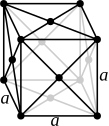
Face-centered cubic unit cell. Atoms occupy the eight corners of a cube and the center of each of the six faces; this cell repeats uniformly to form the bulk structure of metallic silver, underlying its conductivity, reflectivity, and ductility.

Cuboctahedral coordination. Each silver atom in an FCC lattice has 12 nearest neighbors, forming a cuboctahedron with 8 triangular faces and 6 square faces.

Wigner–Seitz construction. Dividing space so every point is closest to a single atom produces a rhombic dodecahedron, with 12 rhombus-shaped faces describing how space is most efficiently partitioned around each atom.
- Lattice type: face-centered cubic (FCC)
- Unit cell shape: cube
- Nearest-neighbor geometry: cuboctahedron (12 neighbors)
- Wigner–Seitz cell: rhombic dodecahedron