the moon is made of silver
a working theory. not officially endorsed. also not officially denied.
People have been calling the moon silver for a very long time.
We are told this is figurative language.
Maybe. But after a while you have to wonder why everybody kept picking the same metal.
The alchemical record
In Western alchemy, silver belonged to the moon. Its planetary name was Luna, and the crescent was used as its symbol. Gold got the sun. Silver got the moon.
This was not some obscure association somebody dug up on Tumblr. It was part of the standard planetary-metal system for centuries.
Then chemistry came along, figured out what silver actually was, and everybody stopped asking why the old guys had been so specific about the moon.
Silver nitrate used to be called lunar caustic.
Not moon-adjacent. Not poetically lunar. Chemists and physicians called a silver compound lunar caustic.
They did not name it that for this page. Somebody got there centuries ago.
Probably nothing.
Geology was not consulted
Most silver does not come from silver mines. It is a byproduct of lead, zinc, copper and gold mining.
Silver literally hides inside other metals' mines.
It also commonly occurs with gold in ores.
This does not prove the alchemists knew anything.
It does mean geology had every opportunity to pick different roommates and declined.
The obvious stuff
Silver is white. The moon looks white.
Silver reflects light extremely well. The moon's entire job description is basically "reflect sunlight at night."
Pure silver has the highest optical reflectivity of any metal. It also has the highest electrical conductivity and the highest thermal conductivity.
It tarnishes too. Ordinary silver tarnish is mostly silver sulfide, which slowly darkens the surface.
So we have a bright silver-colored object associated with a metal whose surface gradually goes dark.
No, tarnish does not cause lunar phases.
Please stop trying to ruin this.
Mirrors
Silver was once the standard coating for high-quality mirrors because it reflects visible light so well.
The moon has been compared to a mirror for thousands of years because it shines by reflected sunlight.
This would be less interesting if silver did not keep turning up every single time humans needed something to reflect light.
Photography made this worse
The first permanent photograph was not made with silver, so we do not get to claim that one.
Nicephore Niepce used a pewter plate.
Fine.
But practical photography quickly became a silver operation.
Daguerreotypes used silver-plated copper. The silver surface was treated with iodine vapor to make light-sensitive silver compounds, exposed in a camera, developed with mercury vapor and fixed.
Light hit silver and left an image behind.
That became one of the basic tricks of photography for more than a century. Silver bromide, silver chloride and silver iodide are all photosensitive.
Before digital photography, an enormous amount of human history was recorded because silver compounds reacted to light.
Birthdays. Wars. Crime scenes. Family portraits. Mountains. Presidents.
And, naturally, the moon.
The moon photographs itself onto silver
John William Draper made one of the first successful photographs of the moon in 1840 using a daguerreotype.
This was almost immediately after practical photography became possible.
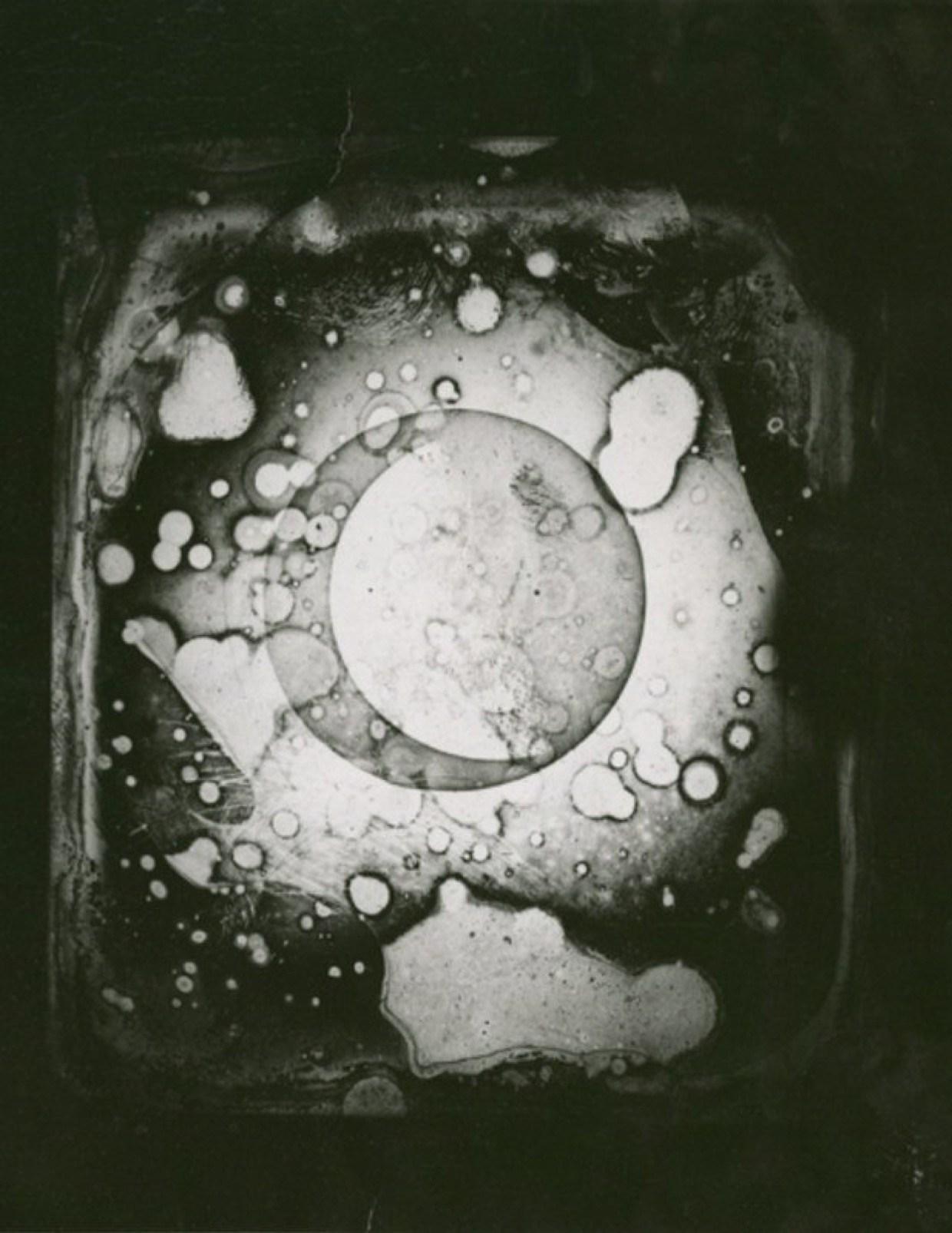
Humanity invents a way of recording light on silver and one of the first things we do is point it at the object we have been calling silver for centuries.
The moon's light then forms an image of the moon on silver.
That is either beautiful or evidence tampering.
I have not decided.
1851 gets weird
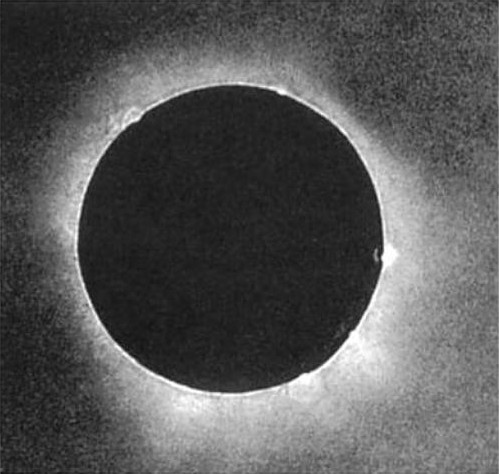
On July 28, 1851, Johann Berkowski photographed a total solar eclipse from the Koenigsberg Observatory.
It was the first successful photograph of a total solar eclipse.
The process was daguerreotype.
Silver.
So one of the first successful photographic records of the moon passing directly in front of the sun was captured on silver.
Also in 1851, the United States started making the silver three-cent piece.
The trime.
This is where things become unnecessarily specific.
The trime
The trime was tiny, around 14 mm across, and the original version was 75% silver and 25% copper.
Congress had just reduced the prepaid letter rate to three cents. A three-cent coin gave people an easy way to pay exactly that amount.
So the United States created a tiny silver coin that lined up almost perfectly with the price of sending a letter.
Communication money.
Put silver on the counter, your message enters the network.
For a while, three cents was basically the packet rate.
Latency was terrible.
The first trimes were only 75% silver because the government wanted the metal value low enough that people would actually spend them instead of hoarding or melting them. Later the fineness went to 90%, but the coin got lighter.
James B. Longacre designed it. One side has a six-pointed star. The other has the Roman numeral III inside an ornamental C.
The New Orleans Mint also struck trimes in 1851. That was the only branch-mint issue in the entire series.
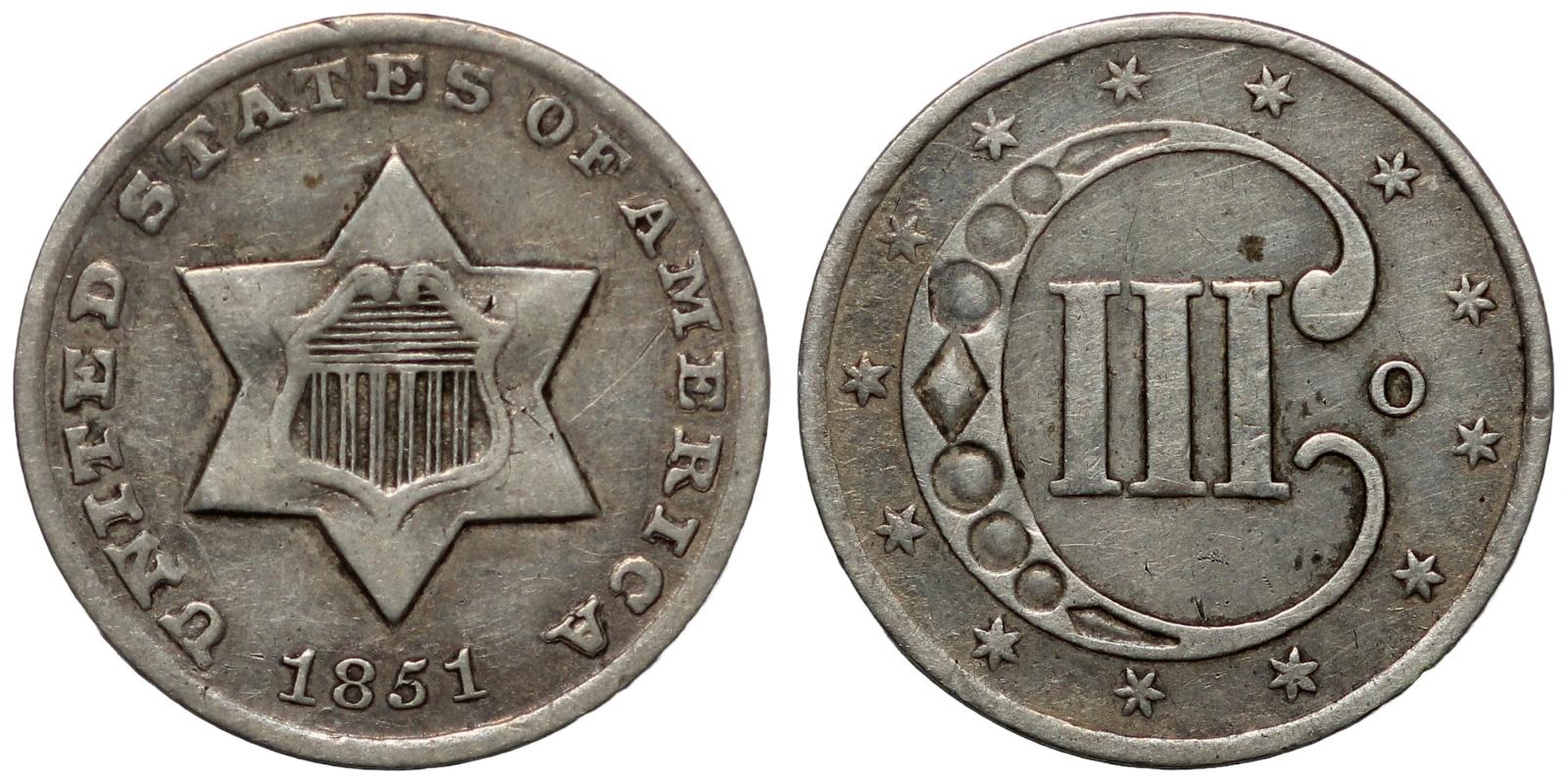
I own an 1852, which is probably why this page exists.
Silver becomes communications infrastructure
The postage connection is one of my favorite parts because it does not require any conspiracy math.
Silver had already become one of the important materials in photography.
Then the government made a silver coin that could directly pay for a common letter.
So in the middle of the nineteenth century you could use silver to record an image, and another piece of silver to send information across the country.
One remembered light.
The other paid to move words.
It was a busy metal.
Railway to the Moon
The Mount Washington Cog Railway opened in 1869.
Sylvester Marsh came up with the idea after climbing Mount Washington in 1852. When he proposed a railway to the summit, the story goes that New Hampshire legislators thought it was so absurd that they might as well let him build one to the moon too.
The "Railway to the Moon" nickname stuck.
This is not technically about silver.
But by this point we have silver photography, silver postage money, the moon being photographed onto silver and a New Hampshire railroad aimed rhetorically at the moon.
I live in New England. I am allowed to include this.
Postcards
The first U.S. government postal cards appeared in 1873.
The trime was discontinued in 1873.
I enjoy this more than I should.
The silver three-cent coin disappears the same year the federal postal card appears.
Picture postcards created another problem. Before 1907, the back of a U.S. postcard was basically reserved for the address. If there was a picture on the front and you wanted to write a message, you wrote around the picture, under it or directly across it.
Which was not ideal once the picture became the reason people were buying the card.
In 1907 the rules changed and the divided back appeared. One half was for the address and the other for the message. The photograph or illustration could finally have the entire front to itself.
That happened right as picture postcards were exploding in popularity.
And photography, of course, was still overwhelmingly a silver business.
So the postcard gradually settles into the form we recognize now: image on the front, communication on the back.
Silver had spent the nineteenth century helping record the image and paying to send the message.
Eventually somebody just put both jobs on opposite sides of the same piece of cardboard.
Real-photo postcards made the connection even more literal. Photographers could print photographs directly onto postcard stock, complete with the divided back and space for postage.
At that point it was not even metaphor anymore. A silver-based photograph on one side, the postal network on the other.
Honestly, the nineteenth century had been working toward this for a while.
Silver iodide goes into clouds
This part sounds like something I would have invented for the page.
Silver iodide is used in cloud seeding.
Its crystal structure helps encourage ice formation in supercooled clouds, so people have deliberately put silver compounds into the atmosphere to try to increase precipitation.
We take silver from the ground, put it into the sky and then wait for water to fall out.
This is called weather modification, which is an impressively boring name for it.
Werewolves
The silver bullet thing is folklore.
The historical connection to the Beast of Gevaudan gets repeated constantly, but the clean modern version of that story is much shakier than people usually admit.
So I would not lean too hard on Jean Chastel.
The underlying silver biology is more interesting anyway.
Silver ions really do interfere with microorganisms. Silver compounds have been used medically for a very long time, and silver still appears in some wound dressings and antimicrobial materials.
So "silver is bad for certain living things" is not entirely fantasy.
Werewolves remain poorly represented in the clinical literature.
Silver remembers light
I keep coming back to this because it is probably the strangest real property in the whole pile.
Silver halides react to light.
For most of photography's history, that meant silver was literally part of the material used to preserve what somebody had seen.
People sometimes talk about old photographs as if the camera somehow trapped a moment.
Chemically, that is not far off. Photons changed silver compounds and left a record behind.
Silver halides were also used in X-ray film. For decades, silver was not only photographing what things looked like on the outside. It was photographing the inside too.
There is something appropriately lunar about that.
It is also the best electrical conductor
Pure silver conducts electricity better than any other metal.
Copper is used for most wiring because it is dramatically cheaper, not because it is electrically superior.
Silver also has the highest thermal conductivity of any metal.
This has absolutely nothing to do with the moon.
I just think it is suspicious that silver keeps winning categories.
Silver harvests the sun
Silver was assigned to the moon. Gold got the sun.
Modern crystalline-silicon solar cells use silver in their conductive contacts because silver carries current extremely well.
So after centuries of being the moon's metal, silver ended up helping collect electricity from sunlight.
Somewhere along the way it crossed departments.
Argentina
The chemical symbol Ag comes from the Latin argentum, meaning silver.
Argentina takes its name from the same root.
This contributes nothing to the moon theory.
I am including it anyway.
Apollo should have ended this
Apollo 11 brought back about 21.5 kilograms of lunar material.
The samples have been studied extensively.
They are rock.
Lunar material is dominated by silicate minerals and familiar elements such as oxygen, silicon, magnesium, iron, calcium and aluminum.
Silver is present only in trace amounts.
This is a serious problem for the theory that the moon is made of silver.
I admit that.
Unfortunately NASA then brought a considerable amount of silver chemistry along for the trip.
Silver and the battery
Alessandro Volta used silver and zinc as electrodes in his early voltaic piles. So silver was present at the birth of the battery, not just its Apollo-era revival.
The Apollo Lunar Module used silver-zinc batteries.
Apollo 11's LM had six primary silver-zinc batteries, four in the descent stage and two in the ascent stage.
The Command Module also used silver-zinc oxide storage batteries.
So the spacecraft sent to determine what the moon was actually made of carried silver to the moon.
Then astronauts collected samples, brought them home and announced that the moon was mostly rock.
Which is almost certainly true.
But from an evidence-handling standpoint, bringing your own silver to the alleged silver moon seems sloppy.
Later lunar rovers used silver-zinc batteries too.
Humans literally drove around on the moon using batteries based on silver chemistry.
Nobody thought to mention this in elementary school.
So is the moon made of silver?
No.
Probably not.
The rocks have become a serious obstacle.
But the older symbolic association starts making more sense once you look at silver itself.
Silver is pale.
Silver reflects light extraordinarily well.
It became a mirror material.
Its compounds made photography possible.
It became tied to images, money, medicine and communications.
It was associated with the moon long before anybody understood its chemistry.
Then humans finally went to the moon carrying silver batteries.
That is good enough for a page called "the moon is made of silver."
We are not writing Nature.
Official position
This is a technical research project.
We do not officially believe the moon is made of silver.
We have no official position on werewolves.
The moon appears to be made mostly of rock.
Silver remains suspiciously involved.